
12 September 2026
Snow, Ice and Rock Salt on a Rochdale Resin Driveway
Most winter advice about driveways is written for concrete and tarmac, and most of it is wrong for resin bound. A permeable surface behaves differently in a freeze, it deals with meltwater differently, and it has a specific set of things that will take years off it - none of which are the cold itself. In Rochdale that matters more than it does in most of the country, because the borough climbs from around 100 metres at the town centre to the moor edge above Littleborough, and the council’s own road temperature sensors sit at Blackstone Edge for exactly that reason. A frost that never touches Heywood can be sitting on Wardle for three days. Here is what is actually safe to put on a resin drive, what is not, and why the answer is not the same as it would be for the slabs next door.
The Cold Is Not the Problem, the Treatment Is
A correctly laid resin bound surface does not care much about frost. The aggregate is bound in a flexible polyurethane matrix with roughly a third of its volume as open void, so water drains through rather than sitting on top waiting to freeze and expand. That is the whole reason a resin bound driveway tends to stay walkable on mornings when a sealed drive has turned into a skating rink. Freeze-thaw damage needs trapped water, and a permeable surface does not trap much.

What does cause damage is the response. Every winter a handful of drives around the borough come back looking dull, scuffed or patchy along the wheel tracks, and in almost every case the owner did something well intentioned with a bag, a blade or a pressure washer. Across the enquiries Longevity handle after a cold spell, surface complaints are far more often traceable to de-icing and snow clearing than to the frost that prompted them.
You are not really protecting the drive from ice. You are deciding how much abrasion and how much chemistry to introduce in exchange for grip, on a surface that lets everything you scatter on it drain straight down into the base.
What Rock Salt Actually Does to the Aggregate and the Binder
Start with the reassuring part. Sodium chloride does not dissolve a polyurethane binder. The resin used on a quality UV-stable system is chemically resilient, which is why it copes with petrol drips, screenwash and brake dust. Anyone telling you that a single scatter of rock salt will destroy your drive is overstating it.
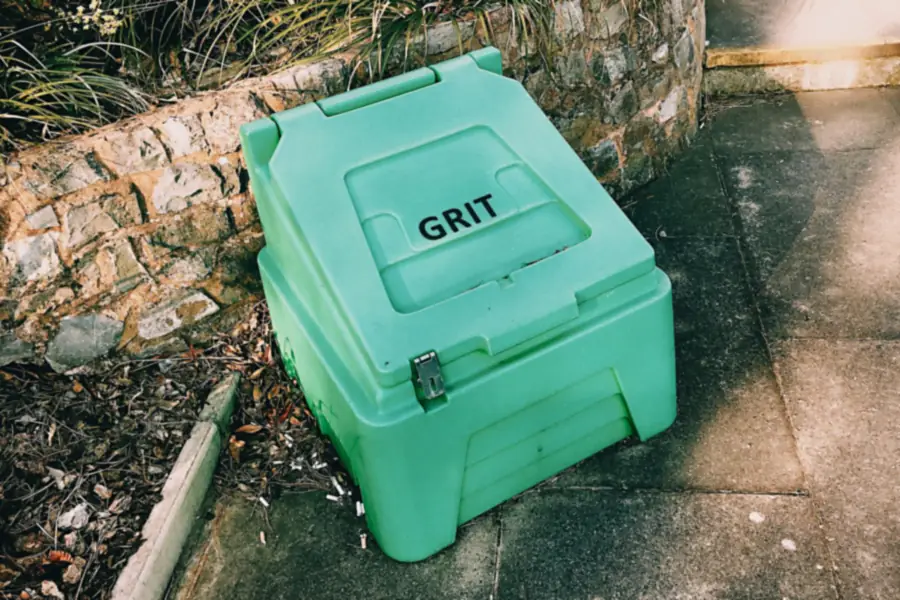
The damage is mechanical and cumulative instead. Rock salt is supplied as hard angular crystals mixed with stone dust, and the moment a car turns on it you have grinding paste sitting between a tyre and the top 2mm of your aggregate. Do that through five or six cold snaps a year and the wheel tracks go flatter and duller than the rest of the drive, particularly on light blends where the polished stone loses its sparkle first. On a dark anthracite you may never notice. On a buff or a silver-grey you will.
Then there is where the chloride ends up. On tarmac the salty water runs off to the gully. On resin bound it goes down, through the surface, into the open-graded base, and sits around whatever is buried in there - the aluminium or steel edge restraint, its fixings, any galvanised channel drain and any reinforcement in a concrete base underneath. Chloride and buried metal is a well understood combination and it is the reason bridge decks and multi-storey car parks stopped being salted decades ago. It is also the reason salty run-off kills the grass strip and the lavender along the edge of the drive, which usually shows up the following May rather than in February.
Sand, Urea and the Proprietary De-Icers Compared
There are really four things people put down, and they fail in different ways. Sharp sand melts nothing and gives pure mechanical grip. It is chemically harmless, but it is fine material being scattered on a surface whose entire performance depends on its voids staying open. Soft builders sand is the worst offender because it packs. If you use sand, use a coarse angular grade, treat the slope and the step instead of the whole drive, and get it off the surface once the ice has gone.
Urea gets recommended as the gentle option, and it is gentle on metal. It is also a nitrogen fertiliser, which on a permeable drive means you are feeding everything the meltwater reaches. In a climate as damp as this one, where moss and algae on the north-facing half of a drive is already the most common maintenance job of the year, deliberately washing nitrogen into the base is an odd choice. It also stops working around minus four, which is not far enough down for a Pennine-edge frost.
Calcium chloride and magnesium chloride work colder than rock salt and are sold as the premium option in garden centres. They carry a heavier chloride load per kilo than sodium chloride does, and they are hygroscopic enough to leave a faintly greasy residue that holds dirt. The right answer is an acetate-based product - calcium magnesium acetate or potassium acetate. Chloride-free, safe around steel and concrete, and the reason they are specified for car park decks. They cost roughly four to six times what rock salt costs per kilo, which is exactly why nobody buys them, and why one tub lasts several winters when you only treat the parts of the drive that need it.
Where the Meltwater Goes on a Permeable Surface
This is the bit that separates resin bound from everything else and it cuts both ways. When snow melts on your drive, the water is not running across the surface to the road. It is going vertically, through the resin layer, into the open-graded stone below, and then either into the ground or into whatever drainage the installer designed. That is why resin drives rarely develop the sheet ice you get on a sealed drive when a sunny afternoon is followed by a hard night.
It also means anything dissolved in that meltwater takes the same route. Salt, urea, screenwash, the chemical de-icer you sprayed on the windscreen while the car was parked - all of it drains into the base rather than washing away. Nothing there is catastrophic on its own. Over fifteen winters it is the difference between an edge restraint that is still sound and one that has corroded at the fixings.
The other thing to watch is imported water. A drive can be perfectly permeable and still freeze if it is receiving run-off from somewhere impermeable - a slabbed path that falls the wrong way, a downpipe discharging onto the surface, or a road camber pushing water up the dropped kerb. That water arrives faster than the surface can take it in, spreads, and freezes on top. If one patch of your drive ices every year and the rest never does, the problem is almost always levels, not the surface. It is fixable.
Shovels, Scrapers and Snow Blowers
Clearing the snow is where most of the real damage happens, and it takes seconds. A steel-bladed shovel dragged across resin bound does not scratch it, it catches the proud edge of a stone and snaps it out of the matrix. Once a few have gone you have small pinholes that fill with grit and show as dark specks. A plastic snow shovel, or a stiff yard brush for anything under about 50mm, does the same job with none of the risk.

Snow blowers are increasingly common on the longer drives out towards Milnrow and Norden, and they are fine if you set them up properly. The failure mode is running the machine with its skid shoes adjusted for concrete, so the scraper bar rides directly on the surface. Set the shoes to leave a few millimetres of clearance, accept that you will leave a thin layer behind, and brush that off. Two-stage machines with a steel auger are the ones to be careful with. A single-stage with a rubber paddle is far more forgiving.
Three things not to do: chip at ice with a spade or an axe, pour boiling water on the surface, take a pressure washer to frozen ground. Boiling water refreezes within minutes as a smoother and more dangerous sheet than what you started with, and the thermal shock does the binder no favours at all. The government’s own guidance on clearing snow and ice from paths and pavements makes the same point about water refreezing, and it applies to your own drive just as much as to the pavement outside it.
Gritting Sloped and Shared Drives on the Pennine Edge
Littleborough, Milnrow, Wardle, Shore and Smallbridge sit meaningfully higher than the centre of Rochdale, and it shows. Rochdale Borough Council monitors road and air temperature from weather stations at Blackstone Edge, Edenfield Road and Heywood Old Road before deciding whether to send the gritters out, and the borough’s winter gritting and salt service runs seven gritters over around 200 miles of priority route, holding roughly 4,500 tonnes of salt at the Princess Street depot. There are about 700 grit bins across the borough, and it is worth saying plainly that those are provided for public roads and footpaths, not for topping up a private driveway.

Altitude is the variable most people underestimate. Met Office regional climate figures put the higher Pennines above 80 days of air frost a year against roughly 30 on the coast, and the Met Office’s explanation of how snow forms and where it settles covers why a few hundred metres changes lying snow so dramatically. If you are on a steep drive up towards the moor edge, you are dealing with more frosts, longer ones, and more melt-refreeze cycles than someone in Castleton. That is also part of why installation and material choices differ up there, something worth reading alongside our guide to resin driveways in Littleborough and Milnrow.
Shared drives add a second problem, which is that somebody else is treating your surface. If you share access with a neighbour, agree what goes down before December. One household putting acetate on their half while the other empties a builders bag of rock salt across the whole thing gives you a drive that ages unevenly along an invisible line. That is an awkward conversation to have in March.
What Actually Voids the Guarantee
Guarantee documents vary between installers and resin systems, so read your own. Do not take anyone’s word for it, including ours. The exclusions themselves are close to universal though, and they are worth knowing before the first cold snap rather than after it.

Damage from mechanical or abrasive action is excluded almost everywhere. That covers metal shovels, ice picks, wire brushes and snow blowers run hard on the surface, and the resulting stone loss has a distinctive look that any installer will recognise. Damage from chemicals not approved by the resin manufacturer is the second clause, and it is the one that catches people who used something aggressive off a shelf without checking. Pressure washing outside a stated pressure and nozzle distance is usually named too, and washing a frozen surface is a reliable way to lift stone.
What is normally covered is the surface failing to do its job - delamination, widespread stone loss without provocation, a base that has moved. The guarantee covers the installation being wrong. It does not cover the drive being treated as though it were concrete. If you are unsure what your own document says about winter, ask before you need to know. It is a two-minute question and it has a written answer.
A Winter Routine That Takes Ten Minutes
None of this needs to be complicated. Before the cold arrives, brush the drive properly and clear the edges, because a surface whose voids are full of leaf mulch and moss drains slowly and is far more likely to hold water that freezes. That single job does more for winter performance than anything you scatter later.

Keep a plastic shovel and a small tub of acetate de-icer in the garage, and treat the parts that matter rather than the whole surface - the slope, the step at the front door, the strip where you get out of the car. Most drives need this perhaps four or five times a winter, not weekly. Clear fresh snow before it gets compacted under tyres, because compacted snow is what turns into ice and compacted snow is what makes people reach for the salt bag.
When the cold snap breaks, give the drive a rinse with a hose to move any residue off the surface and out of the wheel tracks before it gets ground in. That is the whole routine. A resin bound drive laid on a properly built base will go through twenty Pennine winters without complaint if you stop treating it like a supermarket car park. If you want a hand working out whether your surface or your levels are the reason one corner ices over every year, get in touch for a free site visit.
Frequently Asked Questions
Can you put rock salt on a resin bound driveway?
You can, and it will not dissolve the binder, but it is the crudest option available and there are better ones. Sodium chloride crystals are hard and angular, so once tyres start turning on them they act like grinding paste against the top of the aggregate. The chloride-rich meltwater then passes straight through a permeable surface and into the base, where it reaches steel edging fixings and anything else metallic. If it is all you have in the shed, use a light scatter rather than a handful per square metre, and hose the drive down once the cold spell breaks.
Is sand or grit better than salt on a resin driveway?
Sharp sand is kinder chemically, because it does not melt anything and simply gives your shoes and tyres something to bite on. The catch is that fine material can work down into the void structure of a resin bound surface and slow the rate at which it drains. Use a coarse, angular sand rather than soft builders sand, spread it only on the spots that matter such as the slope and the step, and brush or rinse it off as soon as the ice has gone rather than leaving it there until spring.
What is the safest thing to use to de-ice a resin driveway?
A chloride-free de-icer based on an acetate, usually sold as calcium magnesium acetate or potassium acetate. These are the products specified for car park decks and airfields precisely because they do not attack steel or concrete, and they are the only melting agent that carries no penalty when the meltwater drains through the surface into the base. They cost several times what a bag of rock salt costs, which is why most people never buy them, but a single tub covers the handful of frosts a year that genuinely need treating.
Does clearing snow badly void a resin driveway guarantee?
It can, and this is the part homeowners rarely read. Most resin bound workmanship guarantees exclude damage caused by mechanical or abrasive action and by chemicals the resin manufacturer has not approved. A steel-bladed shovel that gouges stone out of the matrix, a snow blower run with its skid shoes flat on the surface, or repeated heavy salting are all reasonably easy for an installer to identify afterwards, and all three sit outside what the guarantee covers. Check the exclusions clause in your own document before the first snow rather than after it.